
 Get A Quote
BLOG
CONTACTUS


DC Motors in Manufacture
DC Motors in Industry: The Unsung Heroes Keeping Factories Moving
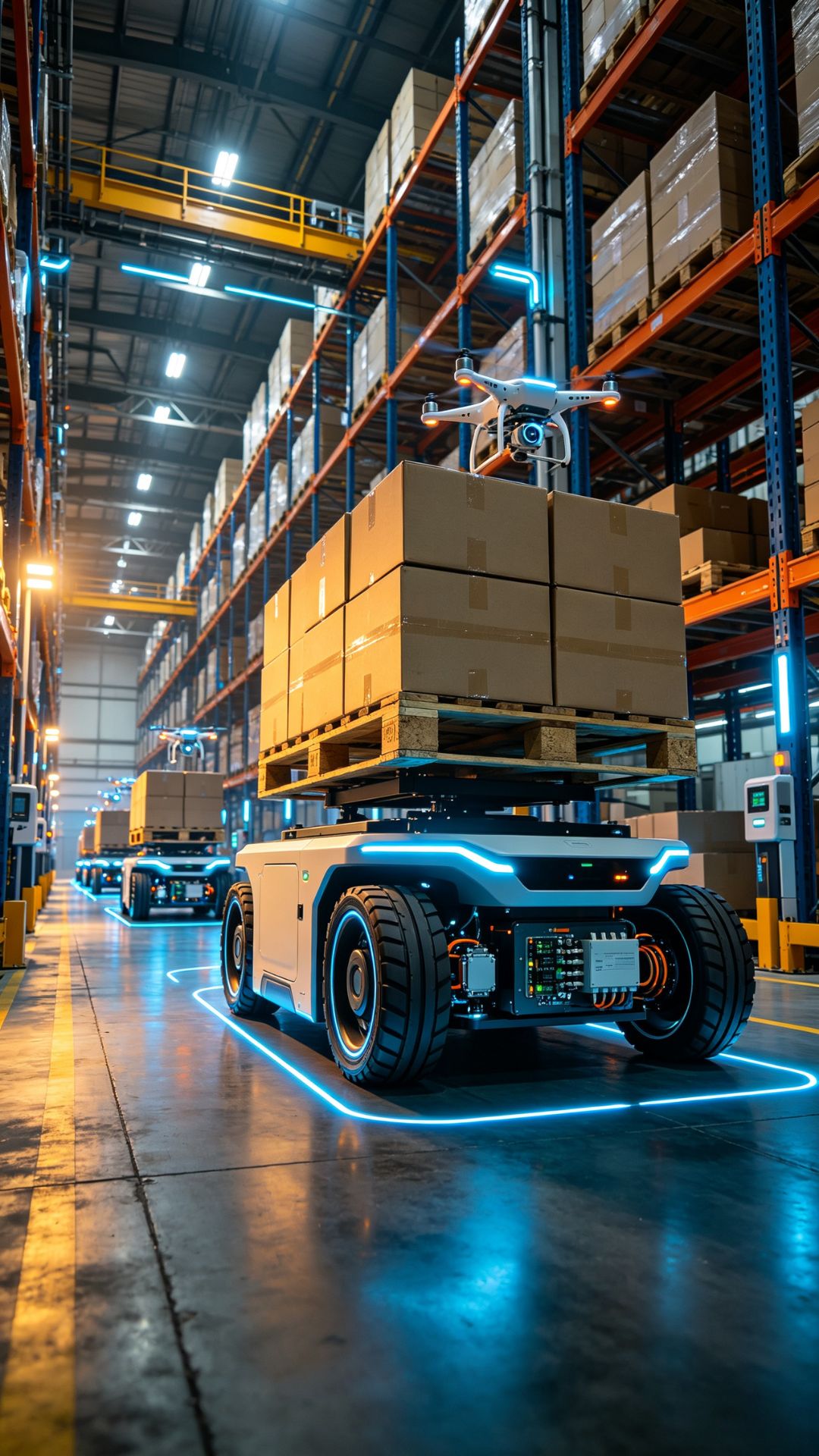
If you’ve ever wondered why a factory doesn’t grind to a halt every five minutes, the answer usually involves a DC motor quietly doing its job in the background. These workhorses are the backbone of industrial automation, powering everything from autonomous warehouse robots to the tools that build our world. Let’s take a look at three key areas where DC motors prove they’re worth every penny.
Industrial AGVs: The Warehouse Robots That Never Call in Sick
Automated Guided Vehicles (AGVs) are the self-driving forklifts of the modern warehouse, and DC motors are what make them move. Most AGVs use 48V or 72V brushless DC (BLDC) motors for their drive wheels, paired with precision encoders that tell the control system exactly how fast each wheel is spinning. A typical warehouse AGV motor delivers 500-2000W of power, allowing the vehicle to haul payloads of 500-2000 kg at speeds of 1-2 m/s—roughly the pace of a brisk walk, but with the strength of a small elephant.
What makes DC motors ideal for AGVs is their excellent low-speed torque control. Unlike AC motors, which can be jerky at low speeds, a DC motor can crawl along at 0.1 m/s with smooth, precise motion—essential when an AGV needs to dock within 2 mm of a charging station or align perfectly with a conveyor belt. Some advanced AGVs even use separate DC motors for steering, enabling omnidirectional movement that lets them slide sideways like a crab. Try doing that with a diesel forklift.
Large Power Tools: When You Need Serious Muscle
Industrial power tools are where DC motors stop being polite and start getting serious. Angle grinders, impact wrenches, jackhammers, and concrete drills all rely on high-power DC motors—often 1000-3000W—to deliver the torque needed to cut steel, drive massive bolts, or break through reinforced concrete.
Take the cordless impact wrench used in automotive assembly lines. A modern 72V BLDC-powered impact wrench can deliver over 2000 N·m of torque—enough to loosen the lug nuts on a semi-truck wheel with a single trigger pull. The key advantage of DC motors here is their ability to produce maximum torque from zero rpm, meaning the tool doesn’t need to “spool up” before it hits hard. This instant torque response is why a DC-powered jackhammer can start pounding the moment the operator pulls the trigger, rather than waiting for the motor to reach full speed.
One clever application is in cordless rotary hammers used for drilling into concrete. These tools use a DC motor to drive a piston mechanism that creates the hammering action, while the same motor also rotates the drill bit. The result? A single motor does two jobs simultaneously, keeping the tool compact enough to hold with one hand while still delivering 10-20 joules of impact energy per blow.
Production Lines: The Invisible Conductors of Manufacturing
If you’ve ever bought anything manufactured in the last 50 years, a DC motor probably helped make it. On production lines, DC motors are everywhere: driving conveyor belts, positioning robotic arms, controlling packaging machines, and synchronizing assembly operations.
Conveyor systems are the most common application. A typical production line might use dozens of 24V or 48V DC gear motors, each driving a section of belt. The beauty of DC motors here is their easy speed control—by simply adjusting the voltage, operators can speed up or slow down the entire line without changing gears or pulleys. When a packaging machine needs to match the speed of an incoming conveyor, a DC motor can adjust its speed in milliseconds, preventing bottlenecks and jams.
Robotic arms on assembly lines use high-precision DC servo motors at each joint, providing the exact torque and position control needed to weld car bodies, install circuit boards, or paint consumer electronics. These motors can achieve positioning accuracy of ±0.01 mm, which is roughly the width of a human hair. That’s the kind of precision that separates a properly assembled smartphone from a very expensive paperweight.
Why DC Motors Win in Industry
The industrial world loves DC motors for three simple reasons: they deliver high torque at low speeds (perfect for moving heavy loads), they offer smooth and precise speed control (essential for synchronized production lines), and they’re reliable enough to run 24/7 with minimal maintenance. As factories continue to automate, DC motors will remain the silent force keeping everything moving—never complaining, never taking a coffee break, and definitely never asking for a raise.
Wuxi Pinghao focuses on the research, development, and manufacturing of DC motors to drive hydraulic and pneumatic mechanisms. Our products are widely used in hydraulic lifting systems for equipment such as trucks and forklifts, as well as industrial conveyor belt systems.