
 Get A Quote
BLOG
CONTACTUS


DC Motors, the Indispensable Workhorses in Forklifts
Forklifts are indispensable workhorses in warehouses, factories and ports around the world. The earliest forklift prototypes emerged in the early 1900s.
In 1917, the Clark Equipment Company developed a truck with lifting mechanism, widely regarded as the ancestor of modern forklifts.
In the 1920s, Yale introduced the platform lift truck. Those early machines were mostly gasoline-powered, bulky and produced heavy exhaust fumes. As indoor warehouse operations expanded, manufacturers began to explore cleaner electric alternatives. By the mid-20th century, direct current (DC) motors gradually became the standard power unit for electric forklifts.
Our four transparent cutaway illustrations clearly show how DC motors work inside electric forklifts.
Figure 1: Overall perspective transparent forklift view
This first image presents a full transparent forklift. It visualizes the basic energy flow: electric current flows into the DC motor. The motor converts electrical energy into mechanical torque. The generated torque drives the wheels for travelling, and also drives the hydraulic pump to lift goods. The core principle is simple: the rotation of the DC motor enables both forklift travel and load lifting.
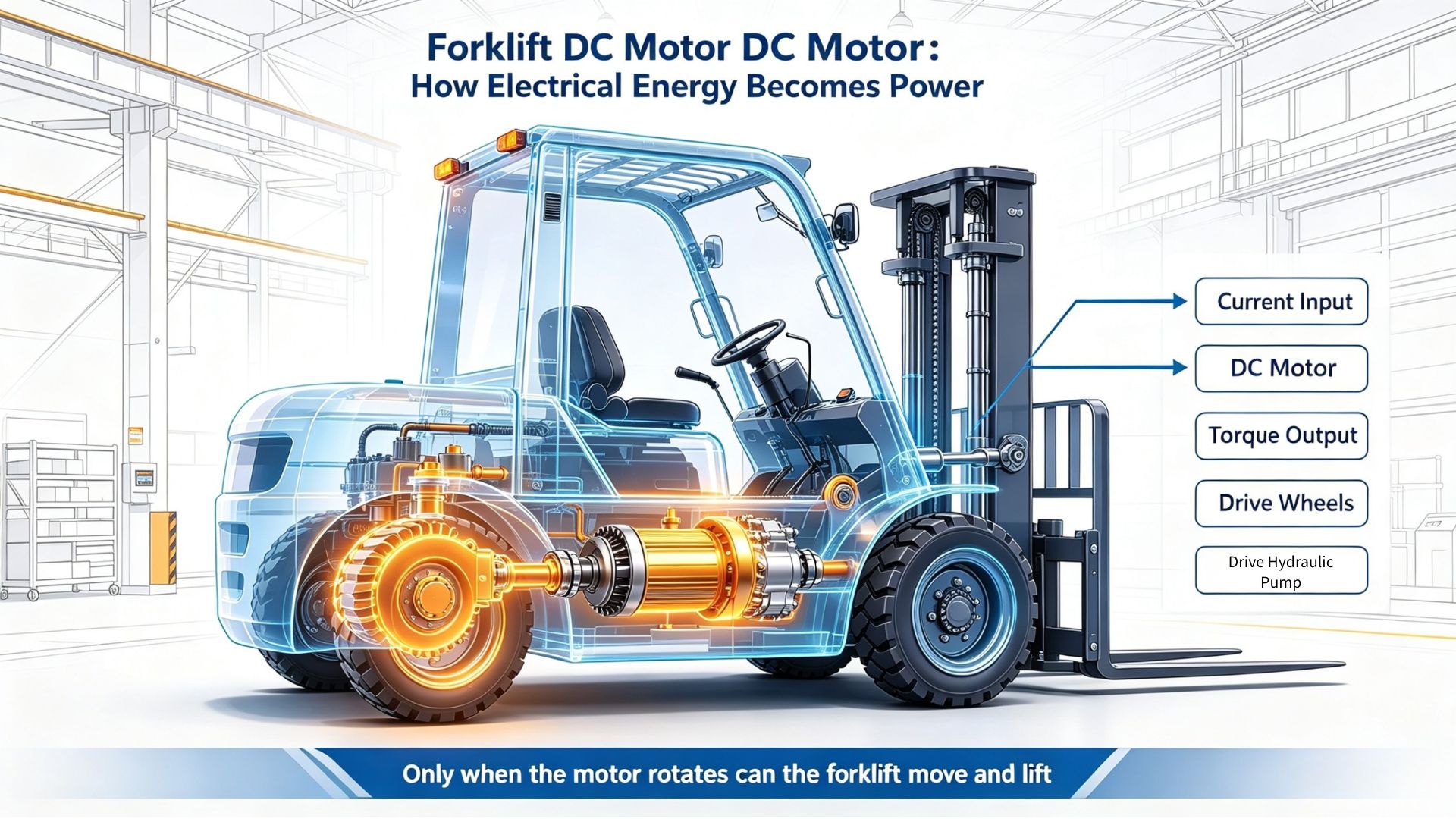
Figure 2: Side cross-section view
The side cutaway diagram reveals the mechanical connection chain. The DC motor connects to the reduction gear set and drive axle. This explains why DC motors are well suited for forklifts: DC motors can deliver high torque at low rotation speed. Forklifts need large pulling force to start and carry heavy loads, a natural advantage of DC motors.
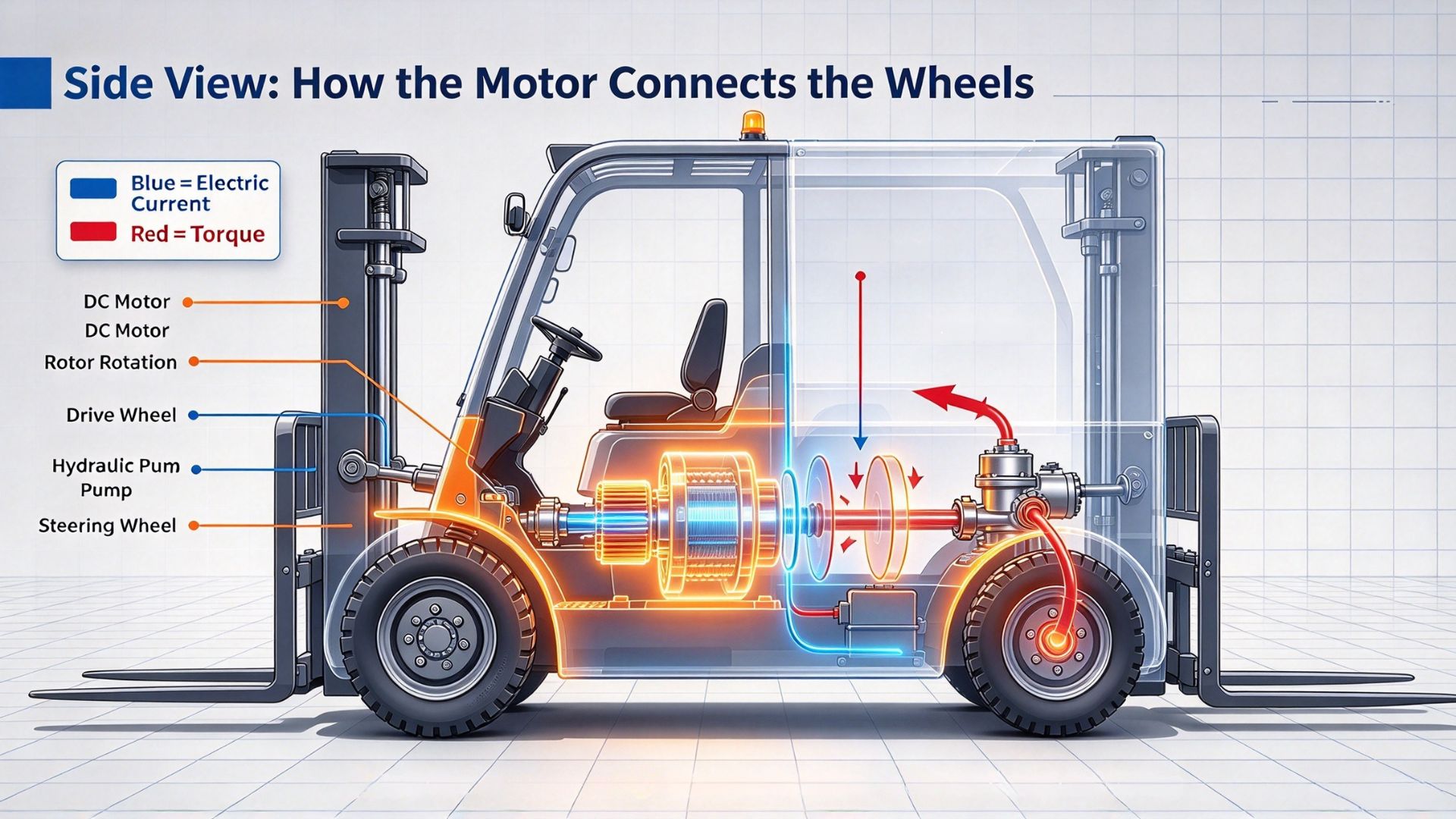
Figure 3: Local enlarged view of motor and transmission
This close-up focuses on the DC motor, coupling and reduction gears. Many people mistakenly think the battery directly turns the wheels. In fact, the DC motor acts as the energy converter. It receives power from the battery, then transfers rotary force through couplings and gears to the drive wheels. The gear system further amplifies torque for heavy payloads.
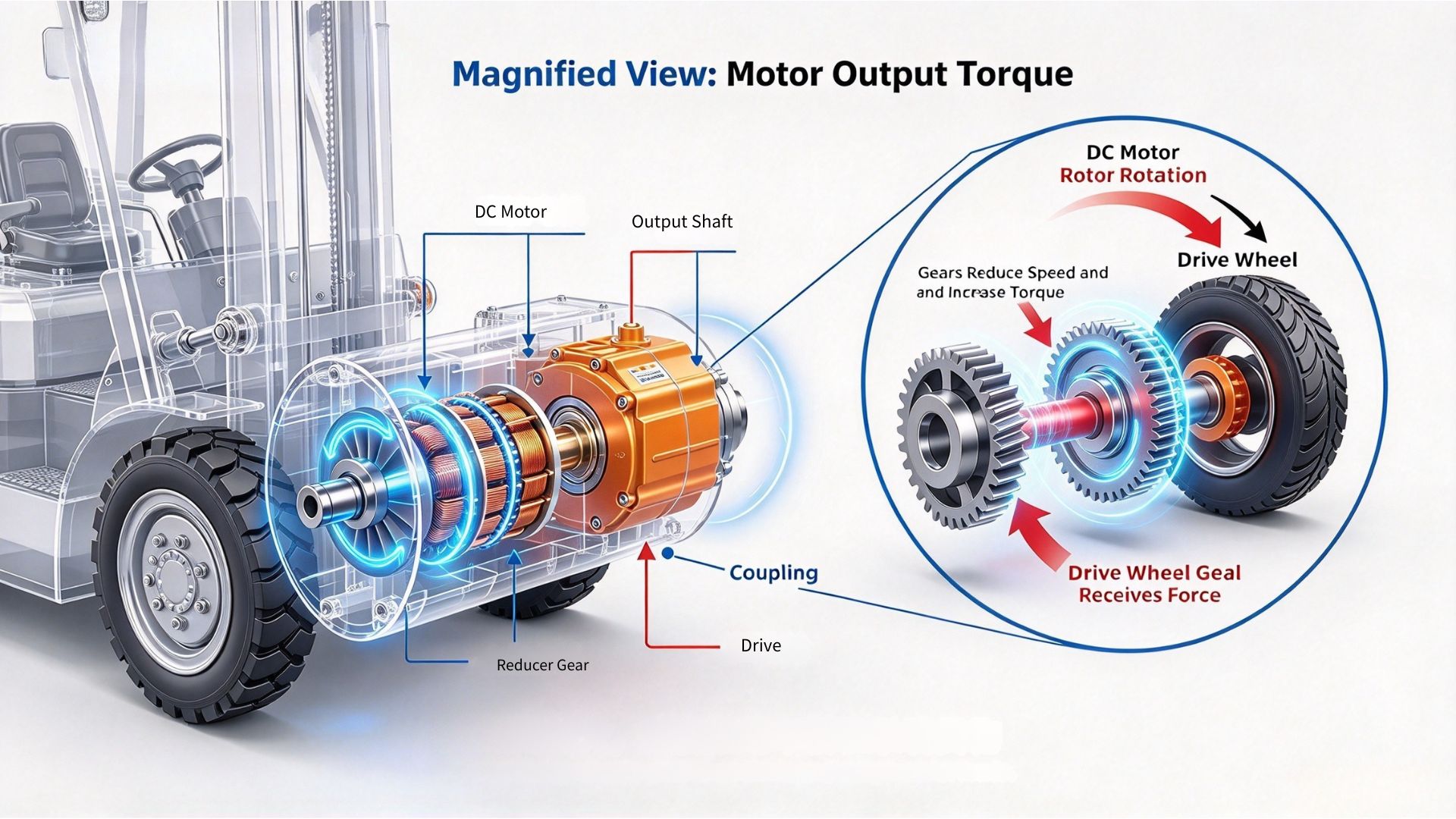
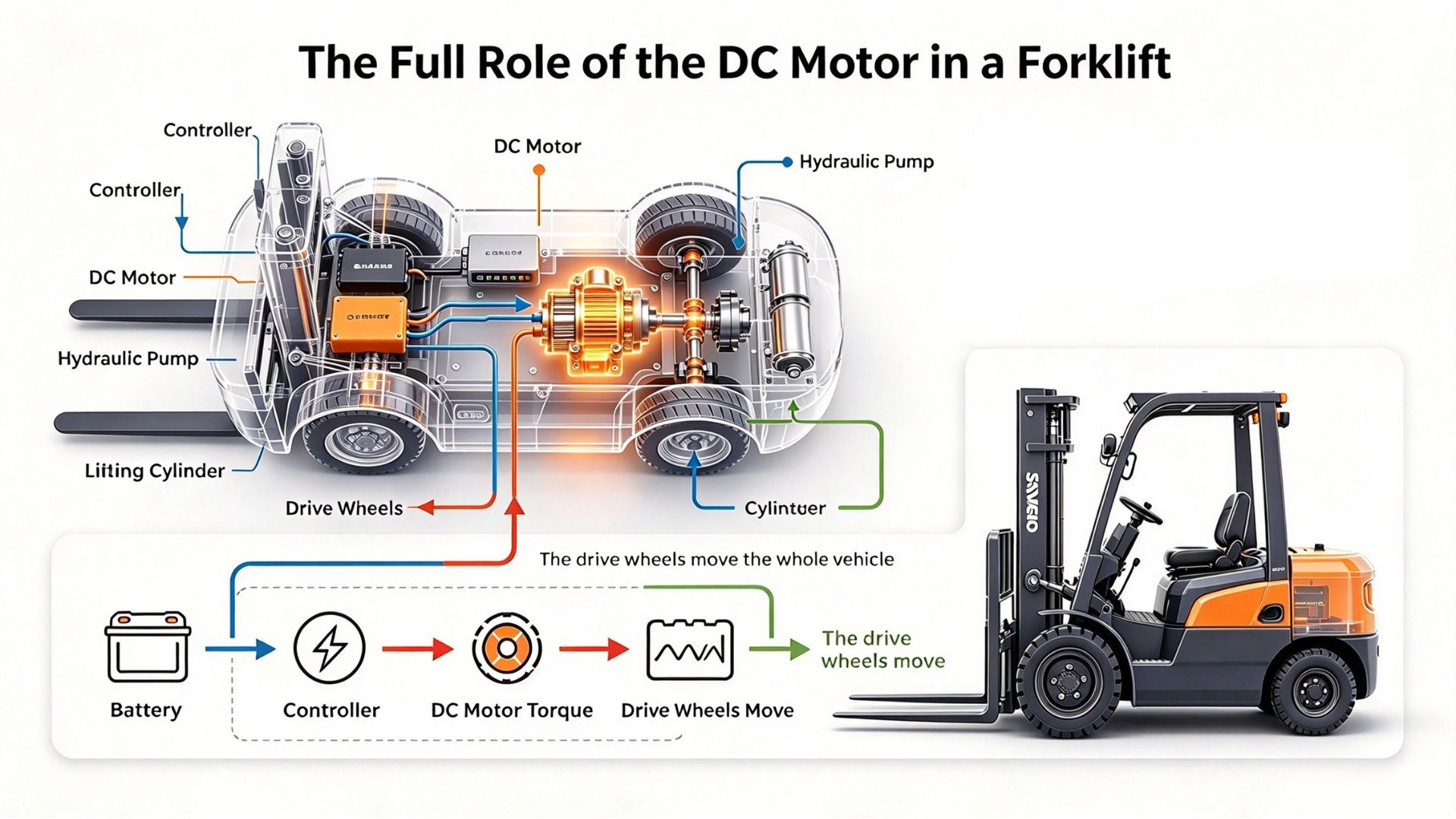
Figure 4: System linkage top-down schematic
The top-down system diagram shows the complete control loop. The battery supplies power to the controller. The controller regulates the current sent to the DC motor. By adjusting the current magnitude and direction, the DC motor can rotate forward or backward, speed up or slow down. Meanwhile, the DC motor drives the hydraulic pump, which pushes hydraulic oil into the lifting cylinder to raise or lower the forks. This single DC motor handles two core tasks: vehicle movement and cargo lifting.
Compared with early internal combustion forklifts, DC motor forklifts have no tailpipe emissions, low noise and stable low-speed torque. Those merits make them ideal for indoor warehouses. For decades, DC motors dominated the electric forklift industry, thanks to simple structure, easy speed control and reliable performance under heavy load.
While AC motors have grown popular in recent years, DC motors still hold an important place in many cost-sensitive material handling scenarios. The transparent renderings help audiences easily peek inside the machine and understand this core power component: the DC motor turns electricity into lifting and moving force, keeping our warehouses moving day after day.